
A teacher's perspective on maximising student engagement with Edrolo
We recently caught up with teacher and Edrolo super user Hollie to understand how she’s using Edrolo and the benefits she’s seeing for teaching and learning.
In our chat Hollie shared her systematic approach to building Edrolo into her teaching strategy—transforming it from an optional under-used resource into a cornerstone of her students' learning journey.
So here's how she's built a simple process to maximise student engagement while simultaneously building crucial independent study skills for her students.
Hollie’s flipped learning approach
Hollie, a Community and Family Studies (CAFS) teacher in NSW, has developed a simple, yet effective system that utilises Edrolo as a key component of her teaching strategy. It’s something that can easily be replicated by any teacher and for any subject.
Rather than using class time for initial content delivery, she assigns Edrolo videos as pre-class homework, enabling students to come to lessons with a foundation of knowledge already established.
Simple, structured implementation
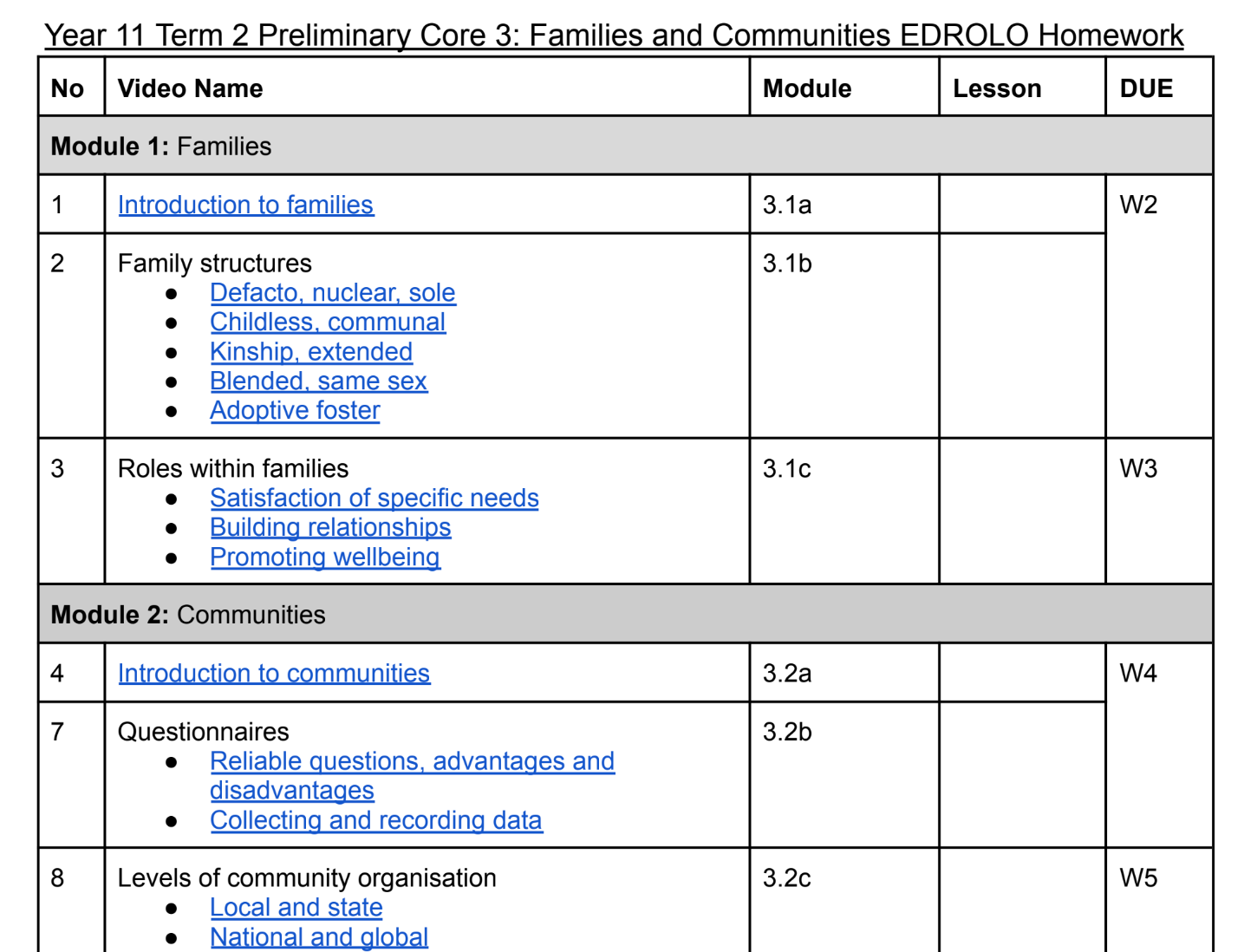
The beauty of Hollie's approach lies in its clarity and structure. Each student receives a term booklet that outlines the weekly Edrolo assignments, complete with links to relevant videos. This transparency helps students manage their time effectively and understand expectations clearly.
"It's literally just a table by lesson," Hollie describes. "I designed a rough outline of what lessons we would cover each week, then copied the links from Edrolo straight into a Google Doc. The students have a hard copy, and the links are also available on Google Classroom."
Transforming classroom dynamics
By having students watch instructional videos before class, Hollie says she can dedicate classroom time to deeper learning experiences:
"We look at scenario-based applications or exam questions based on what they've learned. Students engage in match-up tasks linked to the video content. This way class time focuses on addressing misconceptions rather than basic content delivery."
This approach shifts the classroom dynamic from teacher-centered instruction to student-centered learning.
"I don't really do much teacher talk to be honest," Hollie notes. "The students work in pairs or groups about 50% of the time, with the rest being independent work."
Benefits for all learning levels
The flipped learning model Hollie has introduced offers advantages across the spectrum of student abilities:
"The higher ability students find more opportunities for extension, but equally the lower ability students come in with a pre-understanding of the key terms and terminology. So it's not information overload for them."
For Hollie, the primary goal is "mass practice" – students encounter the material multiple times through different mediums.
"If they're seeing it from Edrolo, then doing it in lessons, then their homework follow-up is the syllabus notes. It's like three birds with one stone."
Building accountability and independence
One of the most significant benefits of this structured approach is the development of student accountability and independent learning skills – crucial preparation for senior studies and beyond.
Hollie has implemented a clear accountability system.
"Hand-ins are every Tuesday. We go through a three-stage system for missed homework – first a free pass where they need to complete it by the end of the day, then a warning with a study session, and finally an N-award for consistent non-completion."
This system helps students develop the discipline needed for success in their final years of school and beyond. The structure benefits both self-motivated students who like to work ahead and those who need more guidance:
"Some of the feedback at parents' evening was that students actually like being held to account. But equally, for the students that want to get ahead, they can do as much as they want in advance to design their own time."
Using data to inform teaching
Edrolo provides valuable data that Hollie uses to monitor student progress and adjust her teaching as needed:
"I check it weekly. The reflection tool helps me determine if we need to revisit certain topics. It also allows me to confirm that students are engaging with the content outside of school."
Students are encouraged to honestly reflect on their understanding, with Hollie emphasising that indicating difficulties with content helps her provide targeted support.
"If you put red, there's nothing wrong with it. It just highlights to me that you want more support with that topic."
Hollie’s tip for teachers
For educators considering a similar approach, Hollie offers practical advice:
"It takes an hour to set up at the start of a term. But once that's set up, it marks itself – you don't have to do any marking. You can check weekly on student progress, their test scores, and their reflections, which can inform your teaching."
"If you work hard in the beginning, it pays off throughout the term. It reduces workload but also ensures students are revisiting content consistently."
Engagement, accountability and content mastery
By integrating Edrolo into a structured flipped learning approach, Hollie has created an educational environment that promotes student engagement, accountability, and mastery of content. This method not only enhances the learning experience but also helps students develop the independent study skills they'll need for future academic success.
Hollie’s approach shows how some simple steps can transform classroom dynamics, allowing for deeper exploration of concepts and more personalised learning experiences.